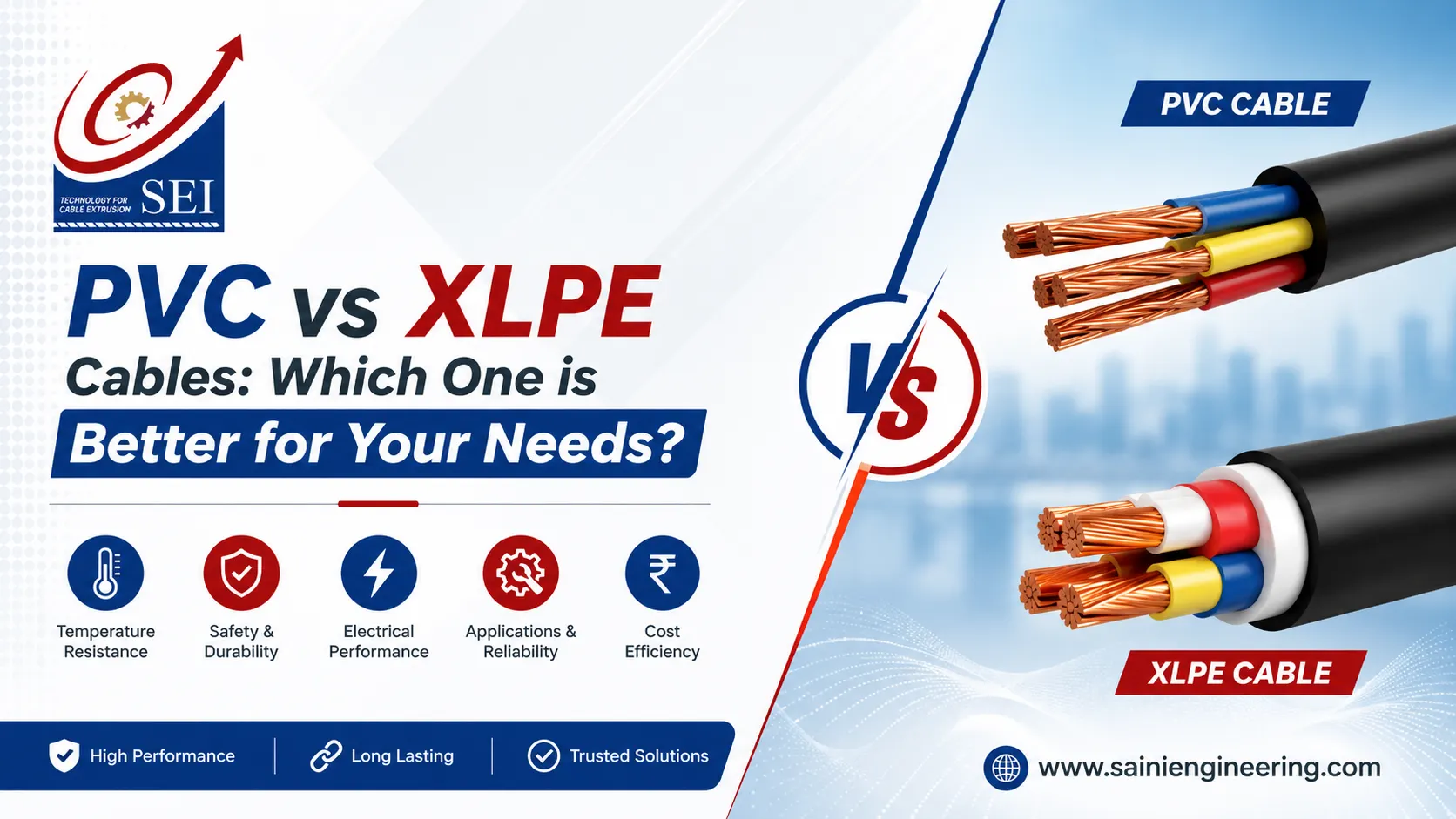
The right cable selection process is essential because it plays a central role in ensuring safety and performance and in creating long-term durability for electrical systems used in industrial applications. Among the most commonly used cable types, PVC vs XLPE cables are widely preferred for residential, commercial, and industrial applications. However, many people often get confused while selecting between these two options. The differences between the two options help industries, engineers, and electricians to select the most suitable solution for their specific project needs.
At Saini Engineering Industries, we believe that having a solid understanding of cable materials and insulation types is essential to achieving efficient electrical performance. The blog will examine all the vital elements that exist between XLPE cables and PVC cables because these two materials show distinct characteristics and benefits, and different industrial uses.
What is PVC Cable?
The PVC cable full form needs to be understood before making any comparisons. PVC stands for Polyvinyl Chloride. It is one of the most commonly used thermoplastic materials for cable insulation and sheathing.
People prefer PVC cables because they offer three benefits, which include low costs, flexible design, and compatibility with different electrical systems. The cables find use in residential spaces, office environments, building structures, and underground systems and applications that require low-voltage electricity.
PVC insulation provides effective protection against moisture, chemical substances, and physical wear, which makes it suitable for use in common wiring systems.
What is XLPE Cable?
The XLPE cable full form is Cross-Linked Polyethylene. The material known as XLPE consists of polyethylene, which undergoes a special chemical process to achieve cross-linking that enhances its thermal and electrical performance.
XLPE cables serve high-performance applications because their design enables them to maintain electrical efficiency while withstanding extreme temperatures and their durability needs. These cables find usage in power transmission systems, heavy industrial operations, substation facilities, and high-voltage power grids.
XLPE insulation provides superior mechanical strength and higher temperature resistance capabilities when compared to PVC insulation.
Understanding PVC vs XLPE Cables
The comparison of PVC vs XLPE Cables requires assessment of six key factors, which include temperature resistance, insulation quality, flexibility, cost, safety, and durability. The two cable types each offer specific benefits that guide users toward selecting the right one for their particular use case.
The major differences between the two things need to be explained through a complete examination.
Temperature Resistance
The main distinction between PVC vs XLPE Cables exists in their ability to handle different temperature ranges.
PVC cables can function effectively until they reach a temperature of approximately 70°C. The insulation material will experience deterioration because of high temperatures, which will impact its performance. XLPE cables operate normally at temperatures up to 90°C, which they can sustain during regular use and emergencies.
Industrial sites that handle heavy electrical loads prefer XLPE cables because they have better resistance to heat compared to other cable types.
Electrical Performance
Electrical efficiency is another important factor when comparing PVC vs XLPE Cables
XLPE vs PVC cable delivers reduced dielectric losses together with improved insulation resistance, which enables them to transmit higher electrical currents with decreased energy waste. PVC cables perform well in normal electrical systems but may not provide the same level of performance under high-load conditions.
Power transmission systems and industrial applications prefer XLPE cables because they offer higher reliability than other cable types.
Durability and Mechanical Strength
The durability of XLPE cables exceeds that of all other materials. Their cross-linked structure provides them with superior mechanical strength and crack resistance, and extended operational lifespan.
PVC cables maintain their strength during normal use; however, their strength decreases when they experience continuous heat and environmental stress.
XLPE cables exhibit superior protection against chemical substances, water, and environmental conditions, which makes them suitable for installation in outdoor and underground environments.
Flexibility and Installation
PVC cables provide better flexibility during installation than their performance requirements. The soft insulation material of the cables enables quick handling and smooth wiring through all types of spaces, which include residential and commercial environments.
The enhanced insulation structure of XLPE cables makes them more rigid than other cable types. The installation process needs additional attention, yet the system delivers better results throughout its entire operational life.
PVC cables provide adequate performance for residential wiring needs and small-scale electrical systems. XLPE cables serve as the standard solution for industrial power distribution needs.
Safety Features
The most essential component of the cable selection process is to focus on safety requirements.
PVC cables may release toxic fumes and dense smoke during fire conditions. XLPE cables provide superior fire protection because they maintain their insulation capabilities at high temperature conditions.
This is one reason why many industries and modern infrastructure projects choose XLPE cables for critical applications.
Cost Comparison
The evaluation of PVC vs XLPE Cables results in cost becoming the main factor that determines their selection.
The better budget option of PVC cables, because of their lower price and greater availability, exists for projects that do not require extreme temperature resistance and high performance capabilities.
The advanced manufacturing process of XLPE cables, together with their superior properties, causes their pricing to exceed that of other cable types. The long operating life of these products, together with their decreased upkeep expenses, causes them to become a beneficial investment for extended periods.
Applications of PVC Cables
PVC cables are widely used in:
- Residential wiring
- Office electrical systems
- Domestic appliances
- Underground low-voltage systems
- Cable trays and conduits
- General electrical installations
Their affordability and flexibility make them highly suitable for day-to-day electrical applications.
Applications of XLPE Cables
Because of their superior performance, XLPE cables are commonly used in:
- Power plants
- Industrial machinery
- High-voltage transmission
- Underground power distribution
- Chemical industries
- Renewable energy systems
- Heavy electrical installations
Their ability to handle high temperatures and electrical loads makes them ideal for demanding environments.
Advantages of PVC Cables
PVC cables offer several benefits, including:
Cost-Effective Solution
PVC cables are economical and suitable for large-scale wiring projects within budget.
Easy Installation
Their flexibility allows easier handling and faster installation.
Moisture Resistance
PVC insulation provides good resistance against water and moisture.
Chemical Resistance
These cables can tolerate exposure to many chemicals and oils.
Advantages of XLPE Cables
Similarly, XLPE cables provide multiple advantages:
High Thermal Resistance
XLPE cables can operate safely at higher temperatures.
Better Electrical Capacity
They can carry higher current loads with improved efficiency.
Longer Lifespan
Their strong insulation structure increases durability and service life.
Excellent Mechanical Strength
XLPE cables are resistant to impact, stress, and environmental damage.
Which Cable is Better for Your Needs?
Your project requirements will determine which option provides the correct answer.
PVC cables serve as an excellent choice for customers who need an affordable and flexible cable solution to use in their homes and light commercial spaces. The product maintains reliable performance during typical electrical conditions while its installation process remains straightforward.
XLPE cables serve as the optimal solution for applications that demand high temperature operation, industrial performance, heavy electrical loads, and extended operational lifespan.
The performance comparison between PVC vs XLPE Cables shows that XLPE cables deliver better results, but PVC cables maintain their market presence due to their cost-effectiveness and ability to serve multiple purposes.
Factors to Consider Before Choosing a Cable
Before selecting between PVC vs XLPE Cables, consider the following factors:
- Operating temperature
- Electrical load capacity
- Environmental conditions
- Installation location
- Budget requirements
- Safety standards
- Maintenance expectations
A proper understanding of these factors can help ensure efficient and safe electrical operations.
Future Demand for PVC vs XLPE Cables
As industries continue to expand and modern electrical infrastructure develops rapidly, the demand for high-performance cables is increasing. XLPE cables are becoming more popular in advanced industrial and renewable energy applications due to their excellent efficiency and durability.
At the same time, PVC cables continue to dominate residential and small commercial markets because of their affordability and practical usability.
Both cable types will continue to play important roles in different sectors depending on application needs.
Conclusion
Selecting the appropriate cable for your electrical system requires knowledge about the distinctions between PVC vs XLPE Cables. The two choices present distinct characteristics that offer different benefits.
PVC cables deliver affordable pricing and flexible design, which makes them ideal for common electrical work, but XLPE cables deliver superior thermal protection and electrical efficiency and industrial strength.
The PVC vs XLPE Cables comparison presents multiple solutions that need to be evaluated based on specific contexts. The right choice depends on your specific project, operating conditions, and performance expectations.
Saini Engineering Industries aims to deliver useful industrial expertise together with educational materials that assist businesses and professionals in making better choices. Your understanding of the essential elements of PVC vs XLPE cables will lead you to choose the right cable solution for your specific requirements.