There have been many changes in the extrusion industry in recent times that have helped companies manufacture plastic materials, compounds, foods, and other industrial products more effectively. The double screw extruder is one such piece of equipment that offers improved performance over traditional extruders in terms of mixing, melting, and processing of materials.
At Saini Engineering, we know how advancements in extrusion technology can help improve performance and quality across various sectors. This is why if you are analyzing the extruder diagram or a twin screw extruder diagram, among others, then you need to be well-versed in the basics of twin screw technology.
What is a Twin Screw Extruder?
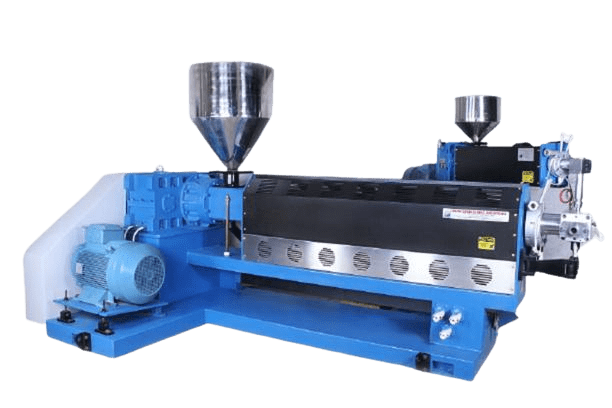
A double screw extruder is a piece of extruding equipment that uses two interacting screws rotating on the same shaft within a cylinder to produce a certain end product. This type of extruder differs from the one-screw extruder in terms of its capacity for proper mixing, even material distribution, and good process control.
Today’s double screw extruder machine equipment is extensively used in the plastic industry, food processing, pharmaceuticals, chemical compound processing, and recycling. In addition to being versatile and efficient, the twin screw extrusion is often chosen by different industries because of the high-quality output it can provide.
When analyzing the extruder diagram of the extruder machine, one can compare the one-screw and twin screw types.
Understanding the Twin Screw Extruder Diagram
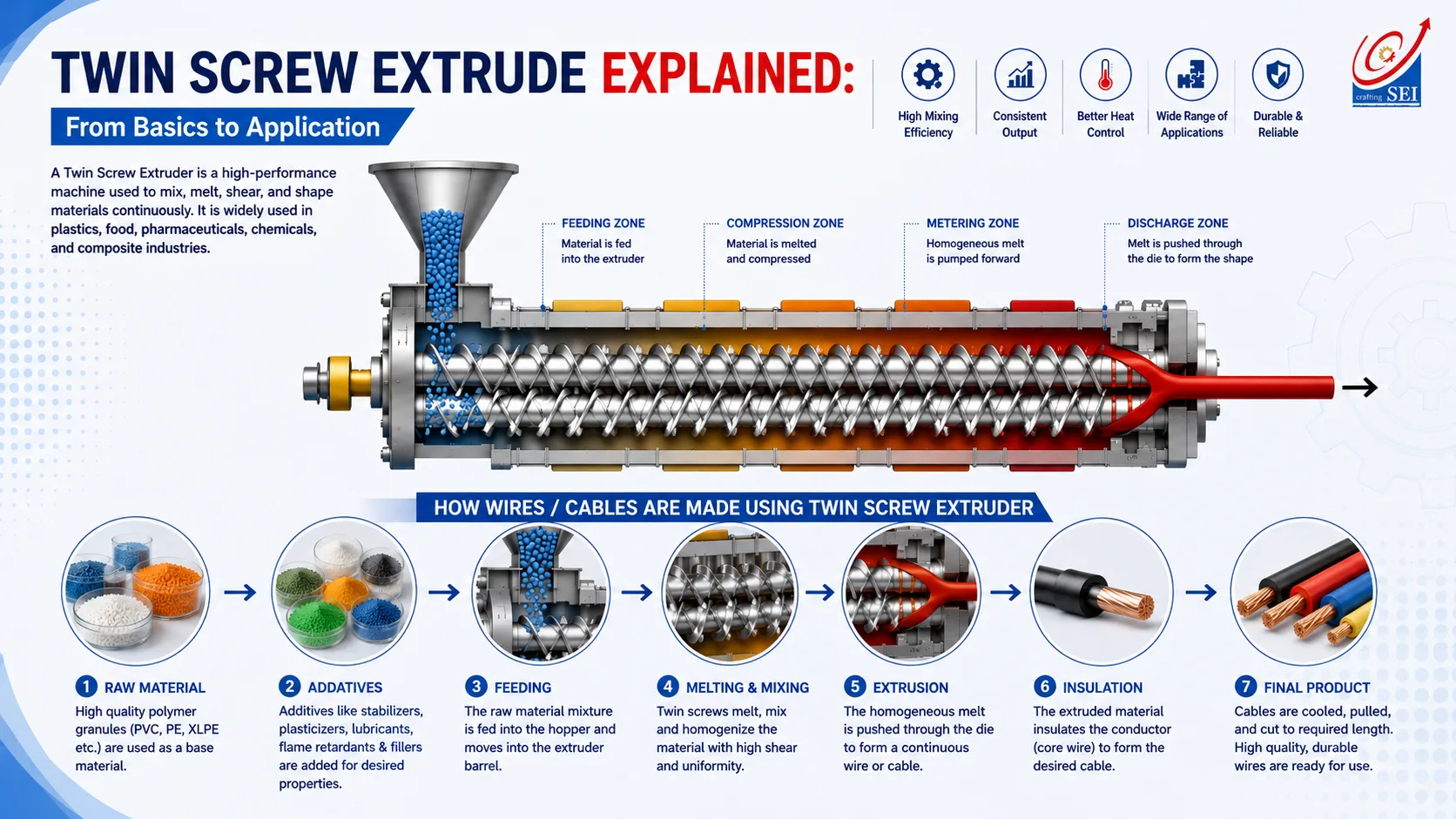
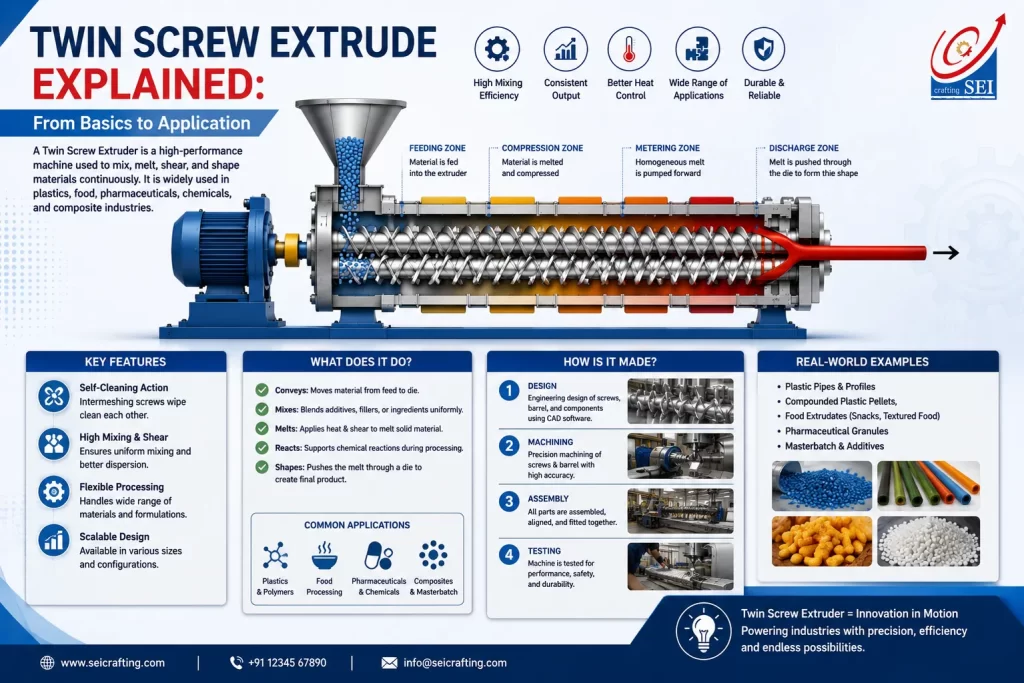
A twin screw extruder diagram provides a visual representation of the machine’s major components and material flow path. Engineers use a twin screw extruder diagram to understand how materials move through the barrel, melt, mix, and finally exit through the die.
A typical twin screw extruder diagram includes:
- Hopper
- Feed section
- Twin screws
- Barrel zones
- Heating and cooling systems
- Venting section
- Die head
- Drive motor
- Gearbox
- Control system
By examining a twin screw extruder diagram, operators can identify critical process zones and optimize machine performance. Every twin screw extruder diagram highlights the coordinated movement of the two screws, which is the key advantage of twin-screw technology.
For process engineers, a well-designed twin screw extruder diagram serves as an important reference for troubleshooting and production planning.
Extruder Diagram and Material Flow
The extruder diagram provides a visual guide for the whole process of extrusion, starting from the feeding process to the completion of the final product. The components shown in an extruder diagram include the hopper, barrel, screw assembly, heating system, and die.
The manufacturers normally make use of an extruder diagram when installing or maintaining the machine. With knowledge on how to read an extruder diagram, one can easily trace any problems in the process.
Regardless of whether the extruder is a double-screw extruder or a twin-screw machine, it is important to understand the diagram of the machine. The well-labeled extruder diagram makes it easier to operate the machine.
Extrusion Diagram Explained
An extrusion diagram shows the complete transformation of raw material into a finished product. Engineers use an extrusion diagram to understand material movement, heat transfer, pressure generation, and shaping processes.
A typical extrusion diagram includes:
- Raw material feeding
- Conveying
- Melting
- Mixing
- Pressurization
- Die shaping
- Cooling
- Final product formation
Every extrusion diagram provides valuable insights into machine efficiency and product consistency. By analyzing an extrusion diagram, manufacturers can improve production quality and reduce waste.
A detailed extrusion diagram is often used alongside a twin screw extruder diagram to explain the complete manufacturing cycle.
Components of a Double Screw Extruder Machine
A modern double screw extruder machine consists of several precision-engineered components designed for high-performance processing.
Hopper
The hopper feeds raw material into the machine.
Twin Screws
The heart of the double screw extruder machine, the screws convey, compress, melt, and mix material.
Barrel
The barrel contains multiple temperature-controlled zones.
Drive System
The motor and gearbox power the double screw extruder machine and control the screw speed.
Die Head
Shapes molten material into the desired profile.
The reliability of a double screw extruder machine depends on the quality of these components. Manufacturers often select a double screw extruder machine when advanced compounding and mixing capabilities are required.
Twin Screw Extrusion Process
The twin screw extrusion process is highly efficient and versatile. It enables continuous production while maintaining excellent product consistency.
Step 1: Material Feeding
Raw material enters the hopper and moves into the barrel.
Step 2: Conveying
The twin screws transport material forward.
Step 3: Melting
Heat and mechanical energy soften the material.
Step 4: Mixing
One of the biggest advantages of the twin screw extrusion process is superior mixing performance.
Step 5: Degassing
Venting zones remove trapped air and moisture.
Step 6: Pressurization
Material pressure increases before reaching the die.
Step 7: Product Formation
The final stage of the twin screw extrusion process shapes the material into the desired form.
Industries prefer the twin screw extrusion process because it offers better control, higher output, and improved product quality. The twin screw extrusion process is especially useful when processing filled compounds, additives, and recycled materials.
Different Extruder Types Used in Industry
There are several extruder types used across manufacturing industries.
Single Screw Extruder
The most common extrusion machine used for standard applications.
Twin Screw Extruder
Provides excellent mixing and compounding performance.
Ram Extruder
Used for specialized materials.
Planetary Roller Extruder
Designed for advanced processing applications.
Among all extruder types, twin screw systems are considered the most versatile. Manufacturers compare various extruder types based on production requirements, material characteristics, and investment costs.
Understanding different extruder types helps businesses select the right equipment for long-term success.
Single Screw Extruder Diagram vs Twin Screw Extruder Diagram
Many companies consider a single screw extruder diagram and a twin screw extruder diagram comparison before investing in their machines.
The single screw extruder diagram represents an extruder that contains one rotating screw in its barrel. It is a simple, economical machine to use for extruding.
On the other hand, the twin screw extruder diagram involves an extruder that has two meshed screws, which offer better mixing.
Single screw extruder diagrams are considered by engineers while analyzing conventional extruders. The comparison of a single screw extruder diagram and a twin screw extruder diagram will enable companies to know the difference between the two techniques.
Although a single screw extruder diagram is a simple diagram, on the other hand, a twin screw extruder diagram is considered an advanced one.
Advantages of Twin Screw Extrusion
The popularity of twin screw extrusion continues to grow because of its numerous benefits.
Superior Mixing
Twin screw extrusion provides excellent material distribution and homogenization.
Better Process Control
Manufacturers can precisely control temperature, pressure, and material flow during twin screw extrusion.
Higher Productivity
Modern systems deliver greater output compared to conventional machines.
Enhanced Flexibility
Twin screw extrusion can process a wide range of materials, including polymers, additives, fillers, and recycled products.
Consistent Product Quality
The advanced mixing capabilities of twin screw extrusion ensure uniform product characteristics.
These advantages make twin screw extrusion a preferred choice for demanding industrial applications.
Applications of Double Screw Extruders
The double screw extruder is widely used across multiple industries.
Plastic Compounding
Color masterbatches, engineering plastics, and specialty compounds.
Recycling Industry
Processing recycled plastics into reusable pellets.
Food Industry
Production of snacks, cereals, and pet foods.
Pharmaceutical Industry
Manufacturing controlled-release formulations.
Chemical Industry
Compounding and reactive processing operations.
A double screw extruder offers the flexibility required for these complex applications. The advanced design of a double screw extruder enables efficient processing of challenging materials.
How Saini Engineering Supports Modern Extrusion Technology
Here at Saini Engineering, we believe that having an understanding of the extruder diagram, the twin screw extruder diagram, as well as the full extrusion diagram, is important when trying to improve manufacturing productivity. Whatever you need help with, whether choosing the correct extruder types, selecting the best double screw extruder machine, or even optimizing your twin screw extrusion process, we can assist you.
We emphasize our expertise in engineering solutions, ensuring that we provide you with state-of-the-art twin screw extrusion equipment.
Conclusion
The twin screw system revolutionized the world of manufacturing by offering better mixing, increased efficiency, and improved flexibility in the process. To be able to make proper investments, it is important to understand the basics of an extruder diagram, a twin screw extruder diagram, a comparison between a single screw extruder diagram, and different extruder types.
If you are thinking of a double screw extruder, using a double screw extruder machine, or improving your twin screw extrusion process, the advantages of twin screw extrusion will prove why this technology is the best one out there.