Precision and consistency are very significant for achieving the best results from modern manufacturing industry operations. One of the key components that is applied in modern extrusion and cable manufacturing plants is known as the Cross Head Diagram. A well-designed cross head can provide uniform distribution of materials, proper coating, and effective production of goods. Knowledge of the cross head diagram and operation process will help manufacturers to increase their productivity level.
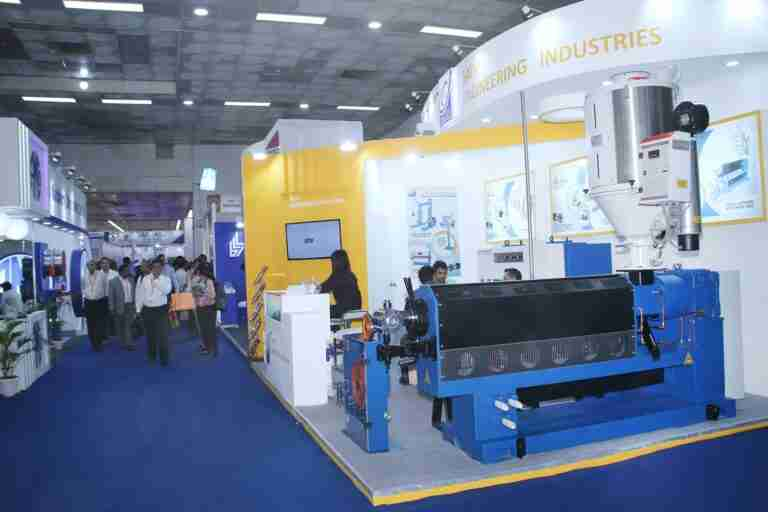
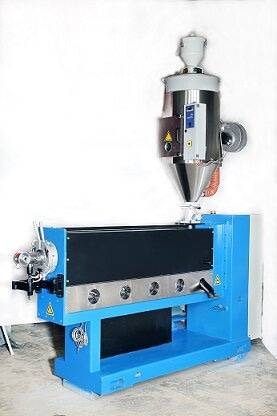
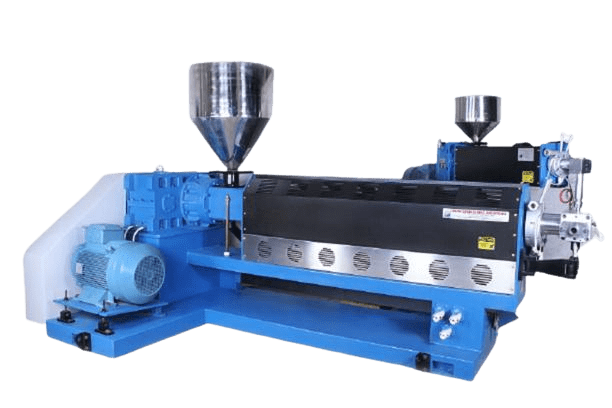
Our company, Saini Engineering, specializes in the manufacturing of cable extrusion equipment and other types of industrial machines. This guide presents basic principles, main characteristics, benefits, and industrial applications of cross head technology.
What is a Cross Head?
A cross head refers to a specific part of an extrusion machine that acts as a distributor of melted material around a central product like wire, cable, tube, or core material. This helps ensure consistent coating and accurate distribution of the material before the exit from the die.
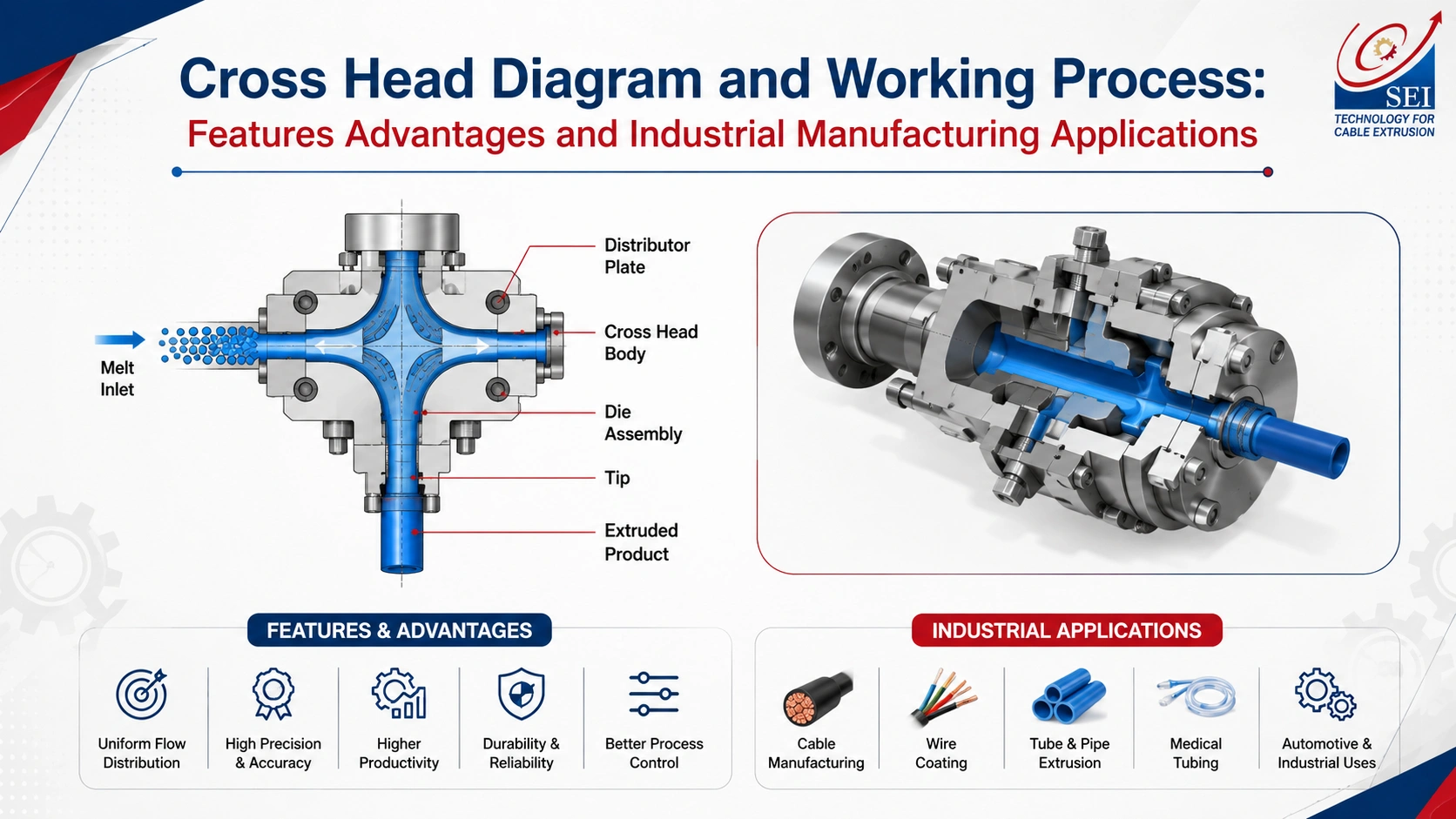
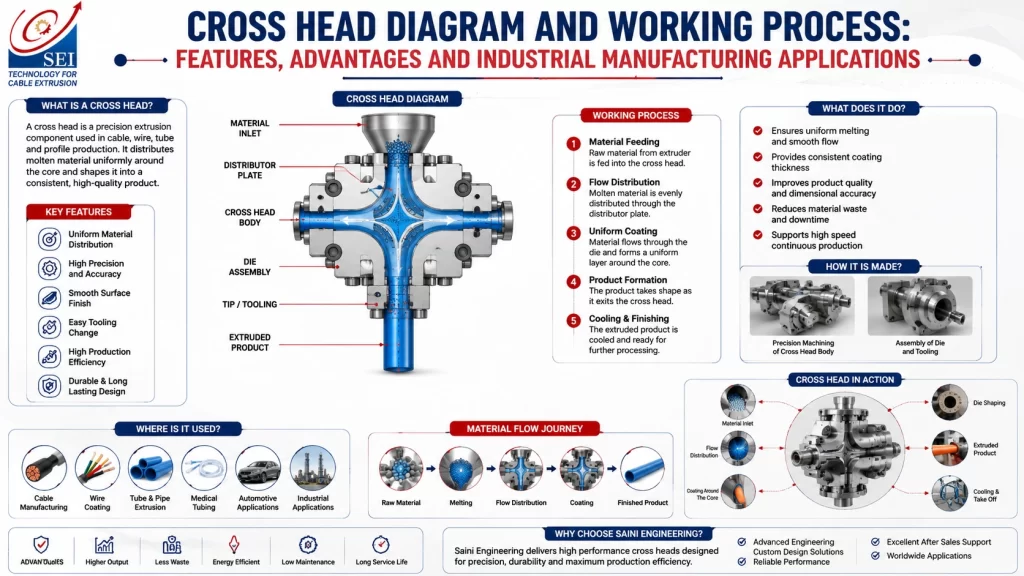
Generally, a cross head drawing will show material entrance, flow paths, the tooling setup, the die portion, and the point of egress of the material as the final product.
Understanding the Cross Head Diagram
A cross head diagram provides a visual representation of the complete extrusion path. The diagram generally includes:
- Material inlet
- Flow distributor
- Cross head body
- Die assembly
- Tip and tooling
- Product outlet
- Heating system
- Pressure control section
Understanding the diagram allows operators to monitor material movement and maintain product consistency throughout the manufacturing process.
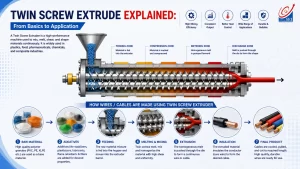
Working Process of a Cross Head
1. Material Feeding
Raw polymer material enters the extrusion system and is melted under controlled temperatures.
2. Material Flow Distribution
The molten material is directed into the cross head diagram, where it is distributed evenly around the product core.
3. Coating Formation
The material flows through precision tooling and forms a uniform coating around the wire, cable, or tube.
4. Product Shaping
The die section shapes the final product according to dimensional requirements.
5. Cooling and Finishing
The finished product is cooled and prepared for further processing or packaging.
This working process ensures accuracy, repeatability, and excellent surface quality.
Key Features of Modern Cross Heads
Precision Material Distribution
Cross heads provide uniform flow distribution, ensuring consistent product quality.
High Production Efficiency
Modern designs support continuous manufacturing with minimal downtime.
Easy Tooling Adjustment
Operators can quickly adjust dies and tips for different production requirements.
Superior Surface Finish
The controlled flow path helps eliminate defects and improve appearance.
Versatile Processing Capability
Cross heads can process various polymers and coating materials.
Advantages of Cross Head Technology
Improved Product Quality
Accurate coating thickness enhances product performance.
Reduced Material Waste
Optimized flow channels minimize unnecessary material consumption.
Higher Manufacturing Speed
Modern systems allow faster production rates without compromising quality.
Better Process Control
Manufacturers gain greater control over pressure, temperature, and flow rates.
Long-Term Reliability
High-quality construction ensures extended operational life.
Industrial Manufacturing Applications
Cross head technology is used in numerous industries including:
Cable Manufacturing
The most common application involves insulation and sheathing of electrical cables.
Wire Coating
Cross heads are used for protective and functional coatings on wires.
Medical Tubing
Precision extrusion is essential for medical-grade tubing production.
Automotive Industry
Various automotive components require accurate extrusion coatings.
Industrial Pipe Production
Cross heads help create consistent pipe and tube products.
Window Crosshead in Architectural Design
Despite the major differences between industrial cross heads and architectural features, the use of the phrase window crosshead is widespread within the building industry. The window crosshead is used for decoration above the windows and helps increase the attractiveness of a facade. Architects often choose the window crosshead to give a building an old-fashioned architectural look. For home constructions, the window crosshead adds to the beauty of the house and fits into other trim decorations around the window.
Door Crosshead Applications
Another decorative item used in buildings above the doors is called a door crosshead. This decoration is commonly used by many businesses to enhance their aesthetics. An appropriately crafted door crosshead will not only make the building look beautiful but will also give a unique feel to the entrance of the building. Door crosshead decoration is commonly used in historic architecture as well.
Cross Water Shower Head and Modern Fixtures
A cross water shower head does not generally pertain to any machinery but to bathrooms and other bathing areas. The cross water shower head aims at maximizing water usage and ensuring the user enjoys a more comfortable shower experience. The reason behind selecting a cross water shower head is its many advantages. Premium bathrooms have the luxury of installing a cross water shower head in order to increase its effectiveness.
Garage Door Crosshead Solutions
In the construction of architecture, the garage door crosshead is used for decorative purposes for garage doors. The garage door crosshead is usually fixed for better coordination and appearance of the exterior side. A well-designed garage door crosshead makes the appearance of your house more beautiful. Garage door cross head diagrams are common in custom-built homes for a high-end look.
Understanding Cross Headed Designs
The phrase “cross headed” is commonly used to refer to any item that has the cross-headed form. A lot of engineered systems are said to be cross headed since they have heads in special designs. The tooling in industries can also be termed as cross headed when materials flow through several channels. Some systems for extruding products are also termed as cross head diagram.
Exterior Crosshead Applications
Exterior crosshead is a type of decoration that is mounted outside on windows and doors. There are instances where many architects opt for the use of an exterior crosshead in order to provide aesthetic value. A well-built exterior crosshead is able to cope with weather conditions without affecting its appearance. Builders normally consider the use of an exterior cross head diagram.
PVC Crosshead Benefits
The use of the PVC crosshead has become very common due to its durability and economical nature. A manufacturer favors using a PVC crosshead in situations where the need for maintenance is minimal. A correctly installed PVC crosshead withstands moisture, corrosion, and any other environmental factors that could affect it. Today, most construction sites have adopted the use of a PVC cross head diagram.
Exterior Window Crosshead Designs
The exterior window crosshead makes for an aesthetic addition above windows. People usually opt for an exterior window crosshead to make their buildings look more elegant, architecturally speaking. An exterior window crosshead can do wonders for any building by making it look more appealing from the outside. The modern architecture makes use of the exterior window crosshead for its aesthetic appeal.
Exterior Door Crosshead Features
An exterior door crosshead will help to create beauty in the exterior entryway of your home. Many architects use an exterior door crosshead in their designs of luxurious houses. An elegant exterior door crosshead will make your exterior look even more inviting. Construction professionals often recommend an exterior door cross head diagram for customizing the look of your exterior door.
How Saini Engineering Supports Industrial Manufacturing
In Saini Engineering, our efforts revolve around offering creative extrusion products that assist in improving accuracy, efficiency, and reliability in production processes. Manufacturers need to understand how the cross head diagram and the entire process work, as this contributes towards improving the efficiency of their production processes.
Conclusion
The cross head diagram is still considered to be a vital part of extrusion and manufacturing processes today. By gaining knowledge of the cross head diagram illustration, process, characteristics, and benefits, manufacturers can achieve greater efficiency, minimize wastage, and guarantee high-quality products at all times. Be it for producing cables, coating wires, manufacturing tubes, or for any other application, cross heads are still indispensable in advanced manufacturing practices.