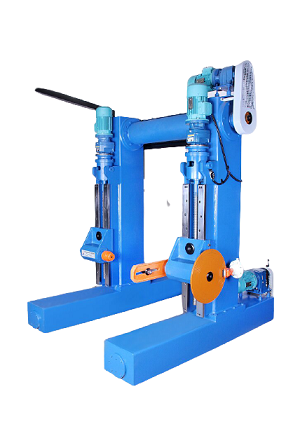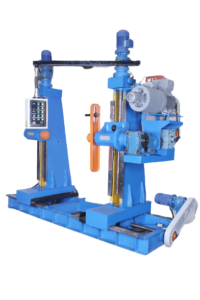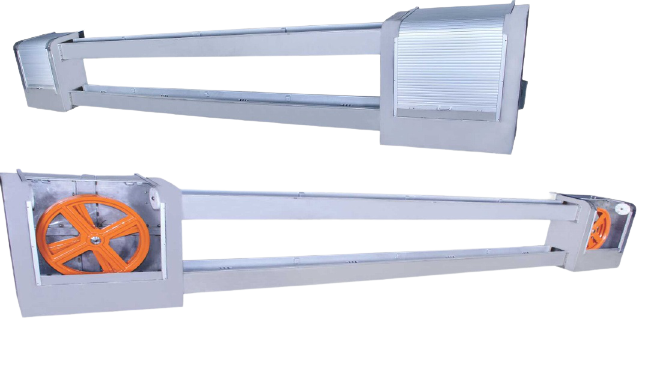
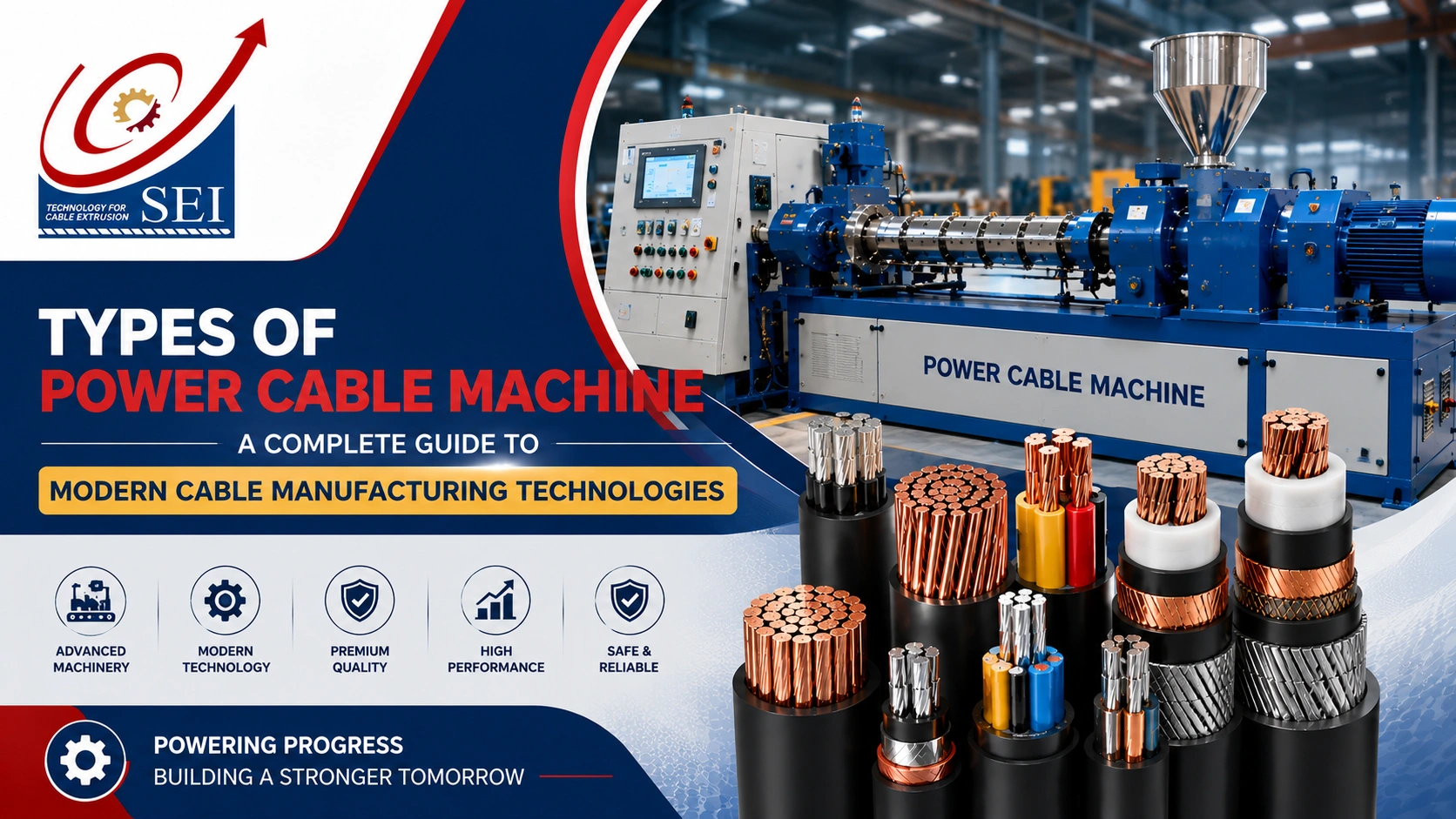
Today, electricity powers the world, and it can only be supplied efficiently through an effective power system. The effectiveness of any power system requires an efficient cable production company to provide effective cables for power distribution to residential areas, business centers, industrial facilities, and even power transmission lines. Modern times call for innovative and sophisticated power cable plant facilities and efficient power cable machines that will support the demands of the industry.
With the adoption of new cable production techniques, modern manufacturing units can produce various types of cables for diverse uses. Knowing about the different kinds of cable plants used today will help businesses and engineers make informed decisions in choosing a suitable production facility.
Saini Engineering Industries has understood the significance of innovation in the cable manufacturing process. This guide highlights some different types of cable plants, their process, power cable machines, and uses.
Understanding Power Cable Manufacturing Plants
A power cable plant is an industrial plant established to produce cables that are used to transmit and distribute electricity and for communication purposes. The processes involved in the manufacture of such cables include drawing wires, insulating, extruding, armoring, sheathing, testing, and packaging.
Modern cable manufacturing facilities are designed to ensure:
- Consistent product quality
- High production efficiency
- Improved electrical performance
- Compliance with safety standards
- Reduced manufacturing waste
As electrical demands continue to evolve, manufacturers invest in advanced power cable Machine systems to enhance productivity and precision.
Why Cable Manufacturing Plants Are Important
Electrical cables are the backbone of modern infrastructure. Without reliable cables, power generation and distribution would not be possible.
Power cable machine manufacturing plants support:
- Residential electrical networks
- Commercial buildings
- Industrial facilities
- Renewable energy projects
- Telecommunications infrastructure
- Power transmission systems
Every type of cable produced serves a specific purpose depending on voltage level, environment, and application requirements.
Major Types of Power Cable Plants
Modern power cable machine manufacturing facilities can be categorized according to the type of cable they produce.
1. Low Tension (LT) Cable Manufacturing Plant
One of the most common facilities in the electrical industry is the LT cable manufacturing plant.
Many people ask about the LT cable full form. LT stands for Low Tension Cable.
These cables typically operate at voltages up to 1 kV and are widely used in residential, commercial, and light industrial applications.
Applications of LT Cables
- Home electrical wiring
- Commercial buildings
- Street lighting systems
- Distribution networks
- Industrial machinery
An LT cable manufacturing plant generally includes:
- Wire drawing machines
- Bunching machines
- Insulation extrusion lines
- Cable laying equipment
- Testing laboratories
Due to growing urbanization, demand for LT cable production continues to increase worldwide.
2. High Tension (HT) Cable Manufacturing Plant
The next major category is the HT cable manufacturing plant.
HT stands for High Tension Cable, which is designed for medium and high-voltage power transmission.
Applications of HT Cables
- Power substations
- Industrial power systems
- Renewable energy projects
- Utility transmission networks
Producing HT cable products requires advanced manufacturing technologies due to the higher operating voltages involved.
These facilities often use:
- Triple-layer extrusion systems
- High-precision conductor processing
- Advanced insulation technologies
- Continuous vulcanization systems
- Automated quality control equipment
HT cable plants are critical for ensuring reliable power transmission across long distances.
3. Extra High Voltage (EHV) Cable Manufacturing Plant
EHV cable plants produce cables designed for extremely high-voltage applications.
These cables are commonly used in:
- National power grids
- Large-scale transmission projects
- Energy infrastructure developments
Manufacturing EHV cables requires highly specialized power cable Machine systems capable of maintaining exceptional insulation quality and conductor integrity.
4. Control Cable Manufacturing Plant
Control power cable machines are used to transmit signals and control functions in industrial environments.
Common Applications
- Automation systems
- Manufacturing plants
- Power stations
- Process industries
Control power cable machines focus on producing cables that offer flexibility, signal reliability, and protection against interference.
5. Instrumentation Cable Manufacturing Plant
Instrumentation power cable machines play a vital role in transmitting measurement and control signals.
These cables are commonly used in:
- Oil and gas facilities
- Chemical industries
- Power generation plants
- Process automation systems
This type of cable requires excellent shielding and signal protection characteristics.
6. Armored Cable Manufacturing Plant
Armored power cable machines provide additional mechanical protection in demanding environments.
Applications
- Underground installations
- Mining operations
- Heavy industrial facilities
- Infrastructure projects
Armoring power cable machine forms an important part of the production process within these specialized cable plants.
7. Solar Cable Manufacturing Plant
The rapid growth of renewable energy has increased demand for solar cables.
Solar cable manufacturing plants produce cables specifically designed for:
- Solar power systems
- Photovoltaic installations
- Renewable energy projects
These cables must withstand:
- UV exposure
- Extreme temperatures
- Moisture
- Environmental stress
As the solar industry expands, specialized cable plants continue to emerge worldwide.
Essential Machines Used in Power Cable Plants
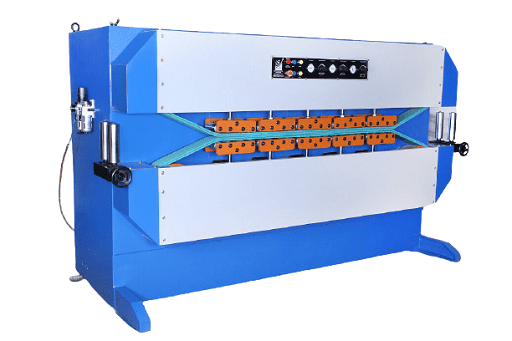
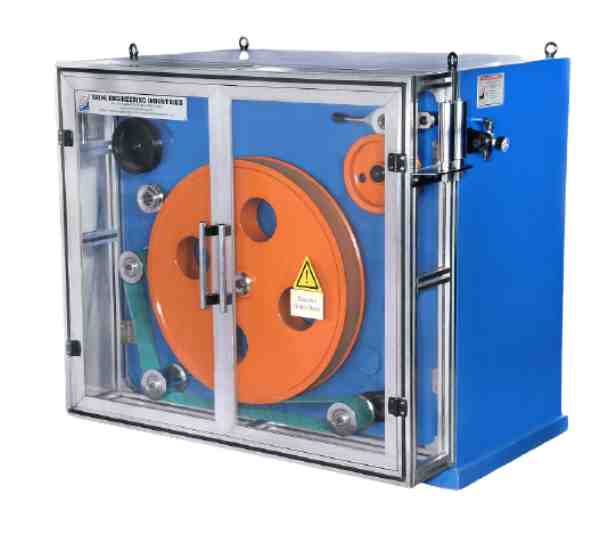
Every modern power cable Plant relies on advanced machinery to ensure efficient production and consistent quality.
Wire Drawing Machine
Converts thick copper or aluminum rods into smaller conductor sizes.
Bunching Machine
Combines multiple wires into stranded conductors.
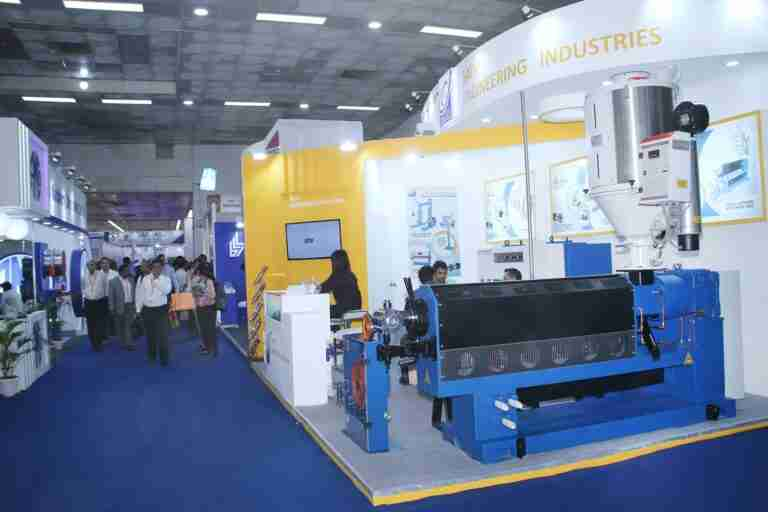
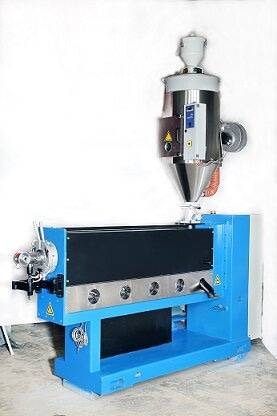
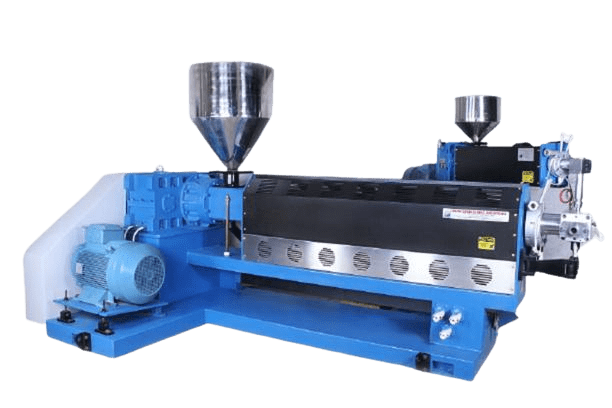
Extrusion Machine
Applies insulation and protective layers around conductors.
Cable Laying Machine
Twists multiple insulated conductors together.
Armoring Machine
Adds mechanical protection layers to cables.
Sheathing Machine
Applies the final protective outer covering.
Testing Equipment
Ensures compliance with electrical and safety standards.
Modern power cable Machine solutions are increasingly automated, enabling higher productivity and reduced production errors.
Cable Manufacturing Process
Regardless of the types of cable being produced, the manufacturing process generally follows similar stages.
Step 1: Wire Drawing
Metal rods are drawn into thinner conductors.
Step 2: Annealing
Conductors are softened to improve flexibility.
Step 3: Stranding
Multiple wires are combined to form conductors.
Step 4: Insulation Extrusion
Insulating materials are applied around conductors.
Step 5: Cabling
Multiple insulated conductors are assembled.
Step 6: Armoring (If Required)
Protective metallic layers are added.
Step 7: Outer Sheathing
The final protective jacket is applied.
Step 8: Testing and Inspection
Finished cables undergo rigorous quality checks before dispatch.
Difference Between LT Cable and HT Cable
Many people confuse the LT cable and the HT cable, but they serve different purposes.
LT Cable
- Low operating voltage
- Residential and commercial applications
- Lower insulation requirements
- Cost-effective installation
HT Cable
- Higher operating voltage
- Industrial and utility applications
- Advanced insulation systems
- Suitable for long-distance power transmission
Understanding the LT cable full form and HT cable classifications helps users select the correct cable for their specific electrical requirements.
Emerging Technologies in Modern Cable Plants
The cable manufacturing industry is evolving rapidly.
Modern plants are adopting:
- Smart automation systems
- AI-based quality inspection
- Energy-efficient production lines
- Digital process monitoring
- Advanced extrusion technologies
- Sustainable manufacturing practices
These innovations improve product consistency while reducing operational costs.
Benefits of Modern Power Cable Manufacturing Plants
Investing in advanced cable production facilities offers numerous advantages:
- Higher production efficiency
- Improved cable quality
- Better electrical performance
- Reduced material wastage
- Faster production cycles
- Enhanced workplace safety
- Greater operational reliability
As demand for electricity and renewable energy infrastructure increases, modern power cable Plant technologies will continue to play a critical role in supporting global development.
Conclusion
Cable manufacture industry is an essential component of today’s infrastructure development. In making LT cable, HT cable, control cable, solar cable, or even customized industrial cable, every power cable plant needs to be equipped with cutting-edge technology for cable production as well as power cable machines.
Knowledge about various types of cable manufacturing plants can help businesses choose appropriate production technologies and boost efficiency as well as product quality. From knowing the LT cable full form to learning about various high voltage cable production techniques, modern cable plants have been contributing significantly to advancement in the electrical industry.
As a company committed to the use of advanced technology in cable manufacturing, at Saini Engineering Industries, we consider ourselves capable of meeting the increasing demands for safe and long-lasting electrical cables.