Copper wire is a material that has been used extensively in electrical systems due to its ability to provide high electrical conductivity and also has high flexibility, longevity, and performance in different situations. Whether it is wiring of households, power generation in industries, motors, transformers, control panels, or communication equipment, copper wire is always needed to transport electricity.
Now, the general question people have regarding this is, ‘Is copper a conductor? ‘ The answer is yes, and there is nothing complicated about it. Copper is actually one of the best commercial and practical conductors of electricity. Because of its specific atomic construction that facilitates the movement of charges within the atom with relatively low resistance, copper can be regarded as good conductors of electricity.
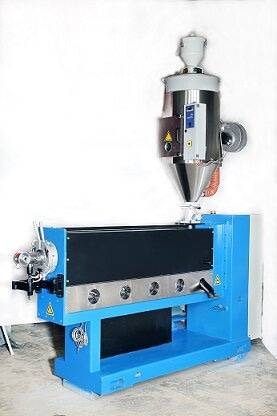
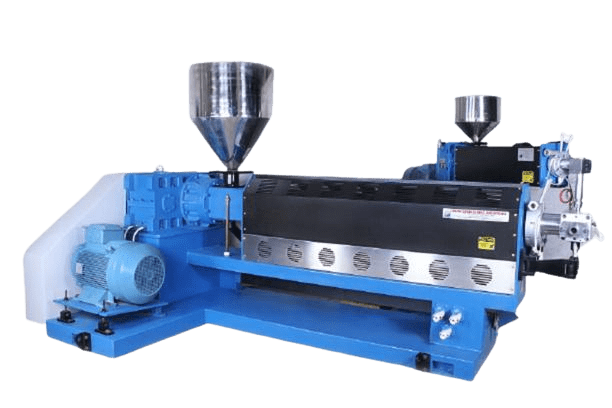
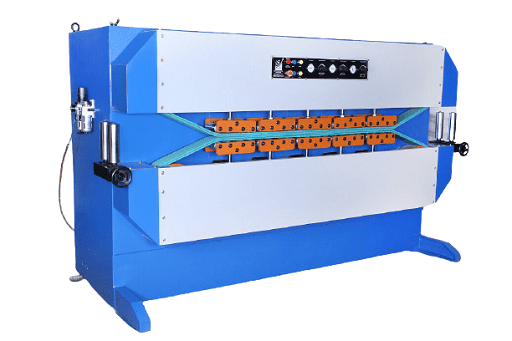
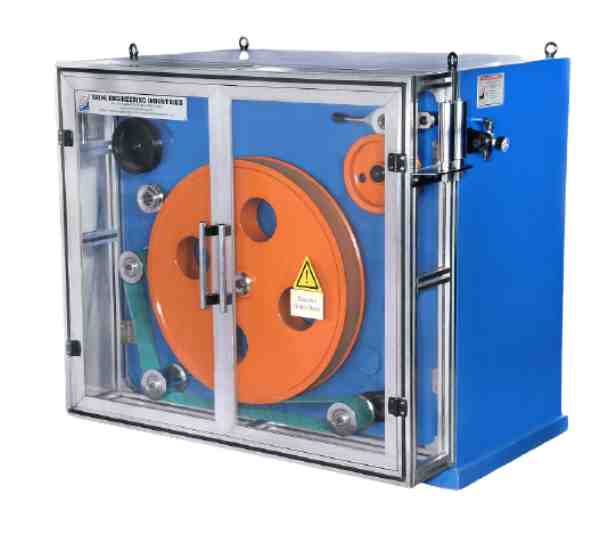
But from the perspective of production companies, manufacturing high-quality copper wires does not depend just on the material. In fact, the quality of the wire produced greatly depends on such factors like machines, stages of production, drawing precision, annealing, insulation, surface finish, and dimensional control of the wire produced. That’s why equipment for copper wire manufacturing is crucial for many producers.
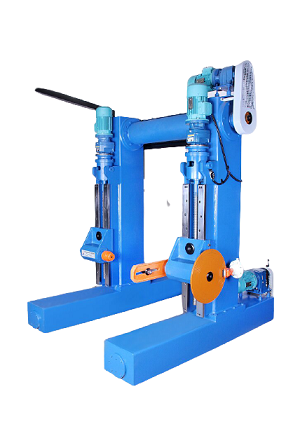
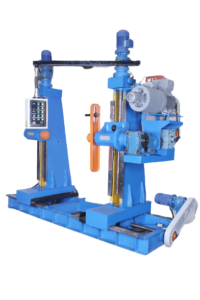
This is precisely what Saini Engineering Industries specializes in – machines for copper wire manufacturing and
What Makes Copper a Good Conductor of Electricity?
Copper’s major feature making it good electrical conductor is its atomic structure. In the atoms of this metal, there are electrons that move around rather easily inside metallic lattice of copper. In case of applying electrical voltage, such free electrons react to electric field causing an electrical current to occur.
In other words, any electric current requires some medium which provides a way for electrical charges to move through. The material with a very low resistivity gives easier passage for the current. Copper has lower resistivity than a number of frequently used metals. That is the reason why it is a good electrical conductor.
It means that copper is able to conduct electricity while providing low level of energy loss due to heating under proper dimensions. It also provides an additional advantage of low cost which becomes a very important factor in production processes.
The second reason why copper is a good conductor of electricity is a set of its characteristics. Silver is a better conductor since it has even higher conductivity of electricity. But copper is cheaper and easier to process. Copper can be produced in form of wires without changing its basic properties.
Is Copper a Conductor? Understanding the Science
When asked, whether it is true that copper is a conductor, the reply will certainly be affirmative because it is considered one of electrical conductors as it conducts electricity without any difficulty.
Metals consist of electrons which are loosely held by the atoms. They can flow through metal structure when voltage is placed on copper wire, as a result, electrons will start to flow under the influence of the electric field.
It is clear that the fact is, why it is good conductor of electricity, as its high conductivity ensures efficient power transmission over the wide area of practical applications when appropriate conductors are designed from copper.
The question of whether copper is a good conductor of electricity depends mainly on such factors as low resistivity, great electron mobility, thermal properties and easy processing, that is why it is popular among engineers dealing with electricity.
Why Copper Wire Performs So Well in Electrical Applications
Copper wire is not selected only because copper conducts electricity. Its overall combination of properties makes it particularly useful for manufacturing electrical conductors.
1. Excellent Electrical Conductivity
The biggest advantage is electrical conductivity. Because copper offers low electrical resistance, it can transfer current efficiently. This is why copper is a good conductor of electricity and why copper wire is widely used in power distribution and electrical equipment.
2. Low Electrical Resistance
Resistance causes electrical energy to be converted into heat. Copper’s relatively low resistivity helps minimize these losses when the conductor is correctly designed and sized.
3. Excellent Ductility
Copper can be drawn into very fine wires. This property is especially important in the wire manufacturing industry because different applications require different wire diameters.
A high-quality drawing process allows manufacturers to reduce the diameter of copper rod progressively while maintaining dimensional accuracy and surface quality.
4. Good Thermal Conductivity
Copper is also an excellent thermal conductor. It can transfer heat efficiently, which is useful in electrical components where heat generation needs to be managed.
5. Flexibility
Copper wire can be manufactured in different forms, including solid and stranded constructions. Fine copper wires can provide excellent flexibility for applications where repeated bending or compact routing is required.
6. Reliable Mechanical Performance
Although copper is highly ductile, properly processed copper wire can provide sufficient mechanical strength for many electrical applications. Manufacturing processes such as drawing and annealing can be controlled to achieve the desired combination of strength and flexibility.
How Copper Wire Manufacturing Machines Improve Wire Quality
Understanding why copper good conductor of electricity is only one part of the manufacturing story. To produce commercial-quality wire, manufacturers need controlled processing.
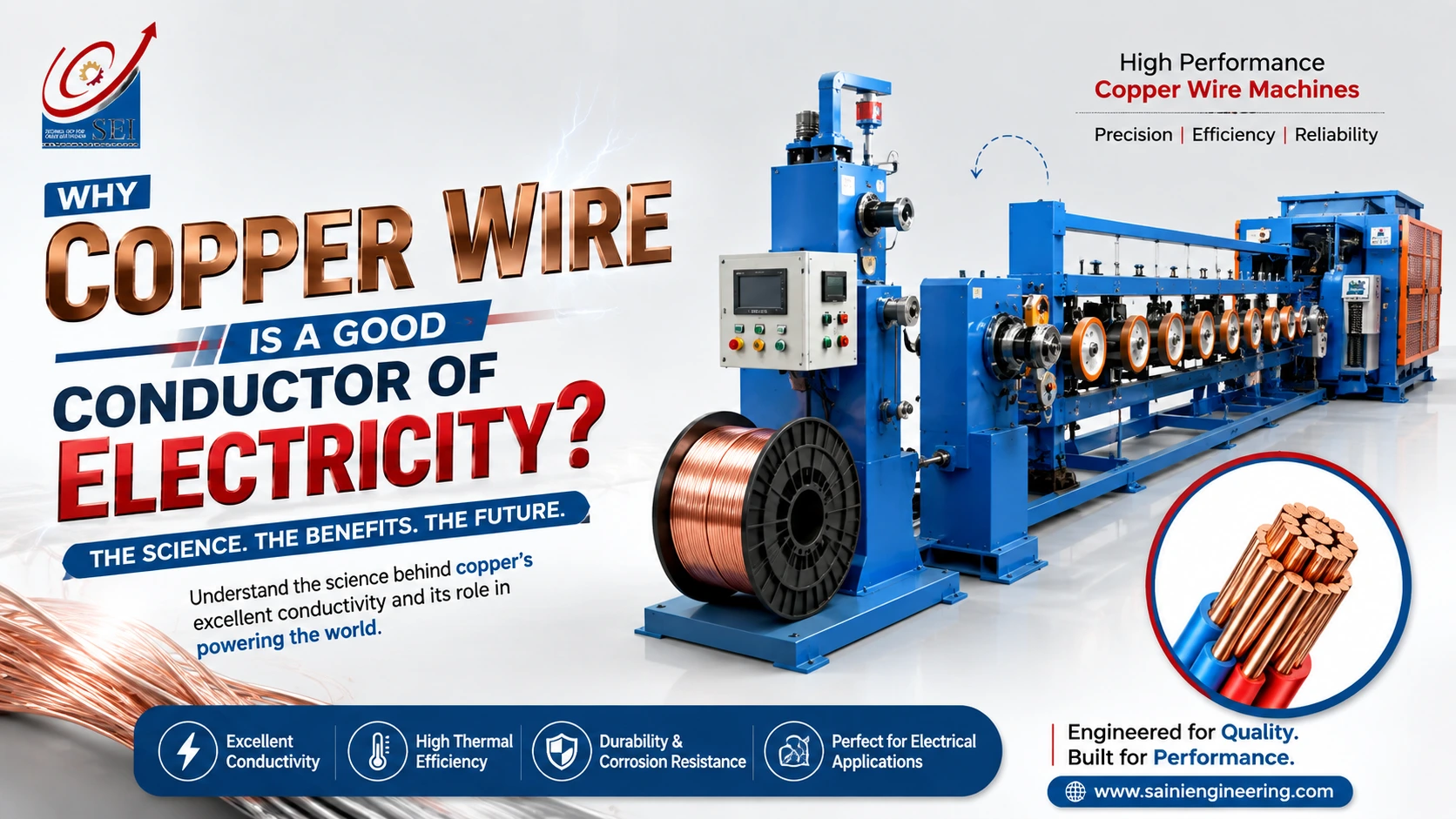
A typical copper wire production process begins with copper rod. The rod passes through a series of dies in a wire drawing machine. Each die reduces the wire diameter progressively until the desired size is achieved.
The drawing process must be carefully controlled because excessive deformation, improper lubrication, incorrect die alignment, or poor cooling can affect wire quality.
A modern copper wire machine can help manufacturers achieve:
- Accurate wire diameter
- Consistent surface finish
- Controlled drawing speed
- Better production efficiency
- Reduced material wastage
- Improved dimensional consistency
- Stable production quality
- Suitable wire flexibility after annealing
At Saini Engineering Industries, copper wire manufacturing machinery can be designed around the production requirements of manufacturers who need dependable and consistent wire-processing performance.
The Role of Wire Drawing in Copper Wire Production
Wire drawing is an essential stage in copper wire production. Copper rod is passed through several different dies with progressively smaller diameters to reduce its cross-sectional area.
In other words, it is analogous to making a wire from a larger piece of copper rod. Instead of making it smaller in one shot, there may be several stages of drawing to make the required wire.
It is crucial to keep in mind that the size of the copper wire is directly responsible for many of its characteristics, such as resistance, ductility, carrying capacity, and applicability.
If properly designed, a copper wire machine will ensure stable conditions throughout the drawing process and result in wire with consistent dimensions.
Why Annealing Matters in Copper Wire Manufacturing
After repeated drawing operations, copper can become harder and less ductile because of work hardening. Annealing is therefore commonly used to restore softness and improve flexibility.
During annealing, controlled heat treatment changes the material’s internal structure and helps improve its ductility. The exact process parameters depend on the copper grade, wire size, production speed, and required mechanical properties.
This stage is particularly important when producing fine copper wire that needs to withstand bending, winding, or repeated handling.
Therefore, when evaluating a copper wire machine, manufacturers should consider not only drawing capability but also how effectively the complete production line manages heat treatment and cooling.
Copper Wire Machine: Important Features for Manufacturers
A professional copper wire production setup should be designed according to the required wire diameter, production capacity, material grade, and application.
Important machine characteristics can include:
- Precision wire drawing system
- Multiple drawing stages
- Accurate die positioning
- Controlled drawing speed
- Efficient cooling arrangement
- Lubrication system
- Suitable annealing arrangement
- Stable wire tension
- Automatic or semi-automatic controls
- Production monitoring
- Safety protection
- Easy maintenance access
The objective is not simply to make wire smaller. The objective is to manufacture wire that meets consistent dimensional, mechanical, and electrical requirements.
Why Copper Remains Important for Electrical Manufacturing
The electric power industry requires materials that are efficient, reliable, useful, and economically viable. In this regard, copper performs much better than most available alternatives.
The high level of copper’s conductivity, malleability, heat properties, anti-corrosion nature, and processability are among the factors that render this material more attractive for different products within the electricity field.
In this respect, the fact that ‘Is copper a good conductor of electricity?’ is not just another scientific inquiry. On the contrary, the answer provides some information about one of the main reasons why this metal became so crucial for today’s electric power industry.
Copper wire still remains an essential element of electrical product manufacturing.
Copper Wire Manufacturing Process
The manufacturing process can vary depending on the final product, but a typical copper wire production process includes several important stages.
1. Copper Rod Selection
Production generally starts with suitable copper rod. The raw material must meet the required quality and composition standards because impurities and inconsistent material characteristics can affect the final wire.
Good-quality raw material provides a better foundation for producing consistent wire.
2. Surface Preparation
Before drawing, the copper rod may undergo appropriate surface preparation to remove unwanted contaminants and prepare the material for controlled processing.
A clean and suitable surface helps reduce the risk of defects during drawing.
3. Wire Drawing
Wire drawing is the central size-reduction process. The copper rod is pulled through dies that progressively reduce its diameter.
This is one of the stages where a copper wire machine plays a major role. The machine must control speed, tension, lubrication, cooling, and die alignment to achieve consistent results.
4. Annealing
Drawing can increase hardness and reduce ductility. Annealing can restore softness and improve the flexibility required for many electrical applications.
The correct combination of drawing and annealing is essential when producing fine copper wire.
5. Cooling
Controlled cooling helps manage process temperature and supports stable production. Excessive heat can negatively influence processing conditions and final wire characteristics.
6. Take-Up and Winding
After processing, the wire can be wound onto suitable reels or coils. Consistent winding is important because uneven winding can create handling problems during subsequent operations.
How a Copper Wire Machine Supports Efficient Production
A modern copper wire machine is more than a simple size-reduction system. It is a combination of mechanical, electrical, control, cooling, lubrication, and monitoring components working together.
The performance of the machine can influence productivity and finished-wire consistency.
For example, unstable wire tension can affect dimensional consistency. Poor lubrication can increase friction and heat. Improper die alignment can contribute to surface defects. Insufficient cooling can affect process stability.
Therefore, manufacturers should evaluate the complete machine system rather than focusing only on maximum production speed.
Key Benefits of Using Copper Wire
Copper’s widespread use comes from several important advantages.
High Electrical Conductivity
The most recognized advantage is conductivity. This is why copper good conductor of electricity has become such a familiar concept in electrical engineering.
Copper provides an efficient pathway for current flow, making it suitable for power transmission, electrical equipment, motors, transformers, and many other systems.
Excellent Ductility
Copper can be mechanically processed into wires with very small diameters. This makes it suitable for applications requiring fine conductors.
Good Thermal Performance
Copper’s thermal conductivity helps transfer heat efficiently. This characteristic is valuable in electrical equipment where thermal management is important.
Long-Term Reliability
When correctly manufactured and installed, copper conductors can provide dependable performance over long periods.
Easy Processing
Copper’s ductility allows it to be drawn, formed, stranded, wound, and processed into different conductor configurations.
These characteristics further explain why copper is a good conductor of electricity for a wide range of commercial and industrial applications.
Major Applications of Copper Wire
Copper wire is used across numerous industries.
Electrical Cables
Copper is widely used in electrical cables because of its conductivity and flexibility.
Motor Windings
Electric motors frequently use copper winding wire because efficient electrical conduction is essential for motor operation.
Transformers
Copper conductors are commonly used in transformer windings. The material’s conductivity and ability to be formed into suitable winding configurations make it valuable for transformer manufacturing.
Generators
Copper wire is also used in generator windings and electrical assemblies where reliable current conduction is required.
Control Panels
Industrial control panels use copper conductors for internal wiring and electrical connections.
Household Electrical Systems
Copper wiring is widely used in residential electrical installations for circuits, connections, and power distribution.
Automotive Applications
Copper conductors are used extensively in vehicle electrical systems because they can be manufactured in flexible wire forms.
Renewable Energy Systems
Solar power systems, battery systems, inverters, and related electrical equipment can use copper conductors for electrical connections.
Copper vs Other Conductive Materials
Copper is not the sole electrical conductor. Other materials such as aluminum, silver, gold, and many others can act as electric conductors. Nevertheless, each of these materials possesses different qualities and weaknesses.
Silver is an excellent electrical conductor but is usually too expensive to be widely used for electric wires. The light weight of aluminum and its suitability for some purposes make engineers choose aluminum but when we speak about conductivity together with compactness and flexibility, we need copper.
Thus, copper takes an important place in the middle of all these qualities.
This is yet another explanation why the question “is copper a conductor” plays a great role in electric engineering – not only does copper conduct electricity but is very practical.
Factors Affecting Copper Wire Quality
Even though copper naturally has excellent conductive properties, finished wire quality can vary depending on manufacturing conditions.
Important factors include:
- Copper purity
- Rod quality
- Wire diameter
- Drawing reduction
- Drawing speed
- Die condition
- Lubrication
- Cooling efficiency
- Annealing temperature
- Annealing time
- Wire tension
- Surface condition
- Winding quality
- Machine maintenance
A manufacturer must control these factors to achieve consistent output.
This is why investing in an appropriately engineered copper wire machine can be valuable for manufacturers looking to improve production consistency and reduce avoidable manufacturing problems.
How to Choose a Copper Wire Manufacturing Machine
Selecting machinery should begin with the manufacturer’s actual production requirements.
Production Capacity
Determine how much copper wire needs to be produced per hour, shift, or day. Machine capacity should match the intended production target without compromising quality.
Required Wire Diameter
Different applications require different wire sizes. The machine should be capable of producing the required diameter range.
Drawing Stages
The number and arrangement of drawing stages should be appropriate for the starting rod diameter and final wire diameter.
Speed Control
Stable speed control helps maintain consistent processing conditions.
Cooling System
Efficient cooling can help manage heat generated during high-speed drawing.
Lubrication
Suitable lubrication reduces friction between the wire and dies and supports smoother drawing.
Automation
Depending on the production environment, automated controls can improve repeatability and simplify machine operation.
Maintenance
Machine components should be accessible for inspection, cleaning, replacement, and servicing.
Why Saini Engineering Industries is Relevant to Copper Wire Manufacturing
For manufacturers who may want to obtain reliable machinery for manufacturing their copper wire, it is also essential for the machine manufacturers to understand the requirements of wire processing.
This is why Saini Engineering Industries has a solution for your machinery in relation to the manufacturing of copper wire. The emphasis should be on obtaining machinery that facilitates controlled drawing and production, as well as its effective use.
Obtaining an appropriate copper wire machine will help you manufacture a wire of consistent dimensions by maintaining stable production conditions. The design of the machine should depend upon a number of things.
Is Copper a Good Conductor of Electricity? Final Answer
But is copper a good conductor? Indeed. The fact that it can transmit electric charges easily throughout its composition makes copper an ideal conductor of electricity.
A good conductor is known to facilitate flow of electric current through it with minimum resistance and copper is no exception in this regard.
When asked whether copper is a conductor, the answer is quite straightforward – it is a good metallic conductor of electricity that is extensively used in conducting wires across the world.
Its features such as low resistance, malleability, thermal conductivity, flexibility, and ease of processing make it an appropriate choice for producing conductors.
At an industrial level, it must be understood that having copper material alone is not enough for getting an efficient product. Processing techniques are important too. It must be drawn, annealed, cooled, and then wound properly.
And here is when a good copper wire making machine plays its role.
Frequently Asked Questions
1. Why is copper used for electrical wires?
Copper is used because it combines excellent electrical conductivity with low resistance, ductility, flexibility, thermal conductivity, and practical manufacturing characteristics.
2. Is copper a conductor?
Yes. Is copper a conductor? It is a highly effective metallic conductor and is extensively used for electrical wiring and industrial conductors.
3. Why is copper called a good conductor?
Copper is called a good conductor because electrical charge can move through it efficiently due to its mobile electrons and relatively low electrical resistivity.
4. Is copper a good conductor of electricity?
Yes, is copper a good conductor of electricity is a question with a clear answer: copper is an excellent practical electrical conductor and is widely used in electrical systems.
5. Why is copper preferred over many other metals?
Copper offers a strong combination of conductivity, ductility, thermal performance, flexibility, durability, and manufacturing practicality.
6. What does a copper wire machine do?
A copper wire machine can process copper rod into controlled wire sizes through operations such as drawing, annealing, cooling, and winding, depending on the machine configuration.
7. Does wire diameter affect electrical performance?
Yes. Wire diameter affects electrical resistance, current-carrying capability, flexibility, and suitability for particular applications.
8. Why is annealing used after wire drawing?
Annealing can restore ductility and flexibility after mechanical deformation caused by wire drawing.
9. Where is copper wire commonly used?
Copper wire is used in electrical cables, motors, transformers, generators, control panels, household wiring, automotive systems, renewable energy equipment, and industrial electrical products.
10. Why is machine quality important in copper wire manufacturing?
Accurate machinery helps control important production variables such as wire diameter, drawing speed, tension, cooling, lubrication, and winding, supporting consistent finished-wire quality.
Conclusion
The superior conductive abilities of copper are precisely why copper good conductor of electricity is considered the basics of electricity studies. Its great current conductivity along with high ductility and thermal properties make it a perfect material for producing different kinds of electrical wires.
The answer to is copper a good conductor of electricity is obvious, but in addition to the appropriate choice of the material, manufacturers also require precise equipment for controlling the production process.
Properly built copper wire machine may become a considerable part of the process helping in obtaining precise dimensions of wires, smooth drawing operations, adequate smoothness and flexibility of the resulting wire, as well as providing sufficient level of production output.
Every process during the creation of the wire from the initial copper rod to the finished product may influence the quality of copper wire. Under proper control and usage of the appropriate machinery and material, one can obtain copper wires which may successfully fulfill their duties in electric industry.
Those manufacturers who need solutions in copper wire production may find Saini Engineering Industries a worthy company providing copper wire manufacturing equipment that is based on realistic industrial needs.