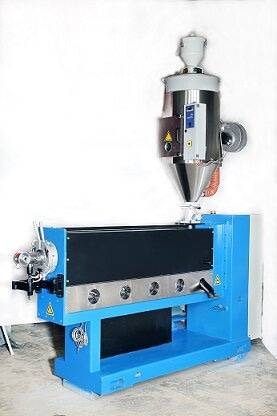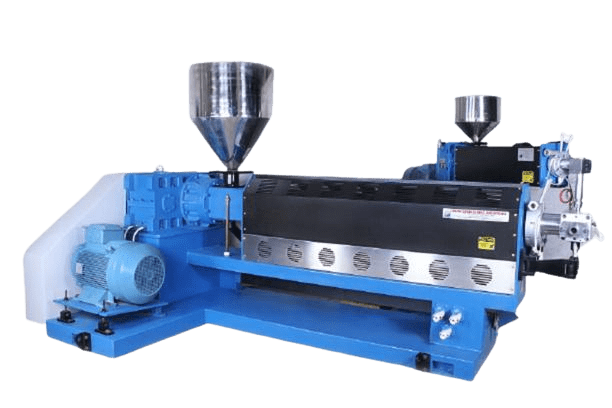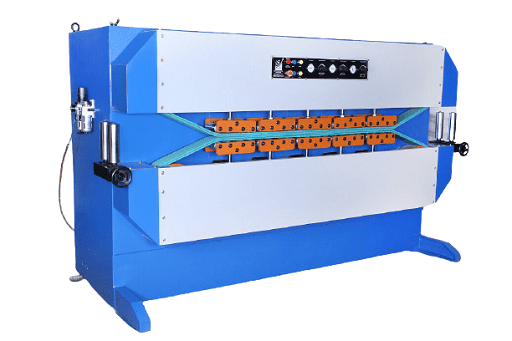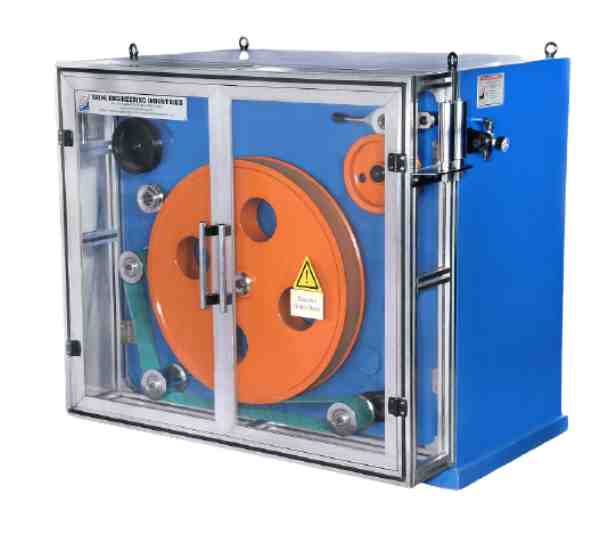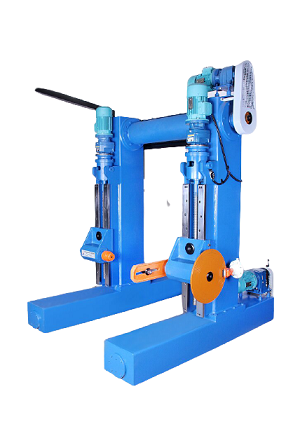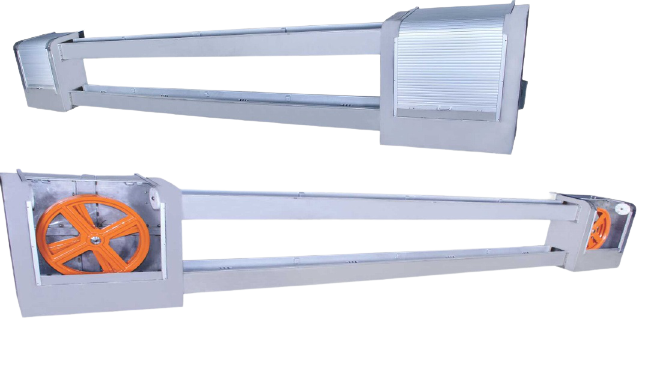
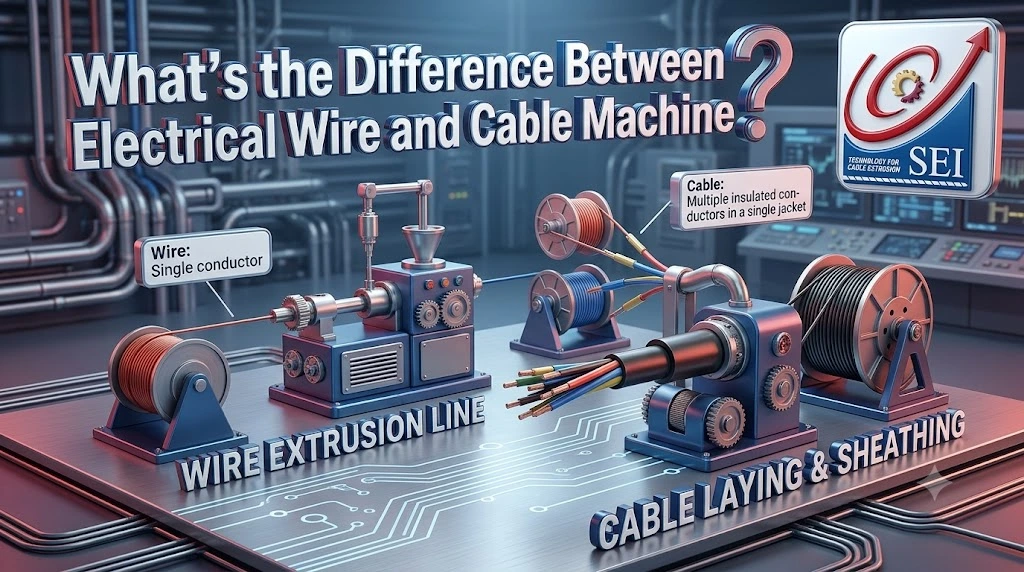
As far as the electrical industry is concerned, manufacturing good-quality products requires excellent machinery that is used in the manufacturing process. Wire machines and cable machines may create confusion among many individuals who think that both of them are used for making electrical conductor products. However, there is a need to understand the difference between wire and cable, machinery, and applications to enable manufacturers, engineers, and buyers.
Knowledge plays an equally important role at Saini Engineering as compared to technology. This guide provides all the information about wire and cable difference, the working of wire and cable machines, specifications, applications, benefits, and other factors required by manufacturers to select the appropriate machine.
The electrical industry is growing rapidly owing to rising demand from infrastructure projects, renewable energy sources, industrial automation, cars, telecommunication networks, and consumer electronics. In such circumstances, the use of high-end wire and cable manufacturing equipment has become very important for maintaining productivity, accuracy, and product quality.
Users search on the internet for the difference between wires and cables, cable and wire difference, and the difference between cable and wire since they wish not only to know the products but also about the machines used in their manufacturing processes.
Understanding Wire and Cable Basics
Before understanding the machines, it is important to know what wires and cables are.
What is an Electrical Wire?
A wire is a single electrical conductor used for transmitting electrical current from one point to another. It may be solid or stranded and is typically covered with insulation for protection.
Common applications include:
- Household electrical wiring
- Electronic devices
- Control panels
- Switchboards
- Industrial machinery
- Automotive electrical systems
What is an Electrical Cable?
A cable consists of two or more insulated conductors bundled together within an additional protective sheath.
Common applications include:
- Underground power transmission
- Industrial power distribution
- Telecommunications
- Renewable energy projects
- Building infrastructure
- Heavy electrical installations
This is the fundamental difference between wire and cable. A wire usually contains a single conductor, while a cable contains multiple conductors grouped.
Difference Between Wire and Cable
The following table explains the wire and cable difference clearly.
Comparison Table: Wire vs Cable
| Parameter | Wire | Cable |
|---|---|---|
| Structure | Single conductor | Multiple conductors |
| Complexity | Simple | More complex |
| Flexibility | Moderate | Higher flexibility |
| Insulation | Single insulation layer | Multiple insulation layers |
| Strength | Lower | Higher |
| Protection | Basic | Enhanced protection |
| Installation | Easier | More complex |
| Applications | Household and electronics | Industrial and commercial use |
| Manufacturing Process | Simpler | Advanced |
| Production Cost | Lower | Higher |
Understanding this difference between wires and cables helps manufacturers determine which machinery is required for production.
What is a Wire Machine?
A wire machine is a specialized manufacturing system designed for producing electrical wires. These machines perform various operations such as drawing, annealing, insulating, winding, and testing.
Main Functions of Wire Machines
Wire Drawing
Reduces the diameter of copper or aluminum rods.
Annealing
Improves flexibility and conductivity.
Insulation Coating
Applies PVC, XLPE, PE, or other insulation materials.
Cooling
Stabilizes insulation quality.
Spooling
Wraps finished wire onto reels.
Testing
Ensures electrical performance and safety.
Components of a Wire Machine
A typical wire manufacturing machine includes:
- Payoff unit
- Wire drawing section
- Annealing system
- Extruder
- Cooling trough
- Capstan unit
- Take-up spooler
- Control panel
These machines are widely used in electrical wire production facilities around the world.
What is a Cable Machine?
A cable machine is designed to manufacture electrical cables that contain multiple conductors. Cable production requires several additional steps compared to wire production.
Main Functions of Cable Machines
Stranding
Combines multiple conductors.
Insulation
Applies individual insulation layers.
Cabling
Bundles insulated conductors together.
Sheathing
Adds protective outer layers.
Armoring
Provides mechanical protection.
Testing
Ensures compliance with industry standards.
Cable manufacturing is more complex because it involves multiple conductors and additional protective layers.
Difference Between Wire Machine and Cable Machine
Many manufacturers search for the difference between cable and wire machinery because selecting the wrong machine can lead to production inefficiencies.
Machine Comparison Table
| Feature | Wire Machine | Cable Machine |
|---|---|---|
| Product Manufactured | Wire | Cable |
| Number of Conductors | Single | Multiple |
| Production Complexity | Low | High |
| Machinery Cost | Lower | Higher |
| Production Speed | High | Moderate |
| Setup Requirements | Simple | Complex |
| Maintenance Cost | Lower | Higher |
| Power Consumption | Less | More |
| Space Requirement | Smaller | Larger |
| Automation Level | Medium | High |
This table clearly explains the cable and wire difference from a manufacturing perspective.
Wire Machine Technical Specifications
The following specifications may vary depending on machine model and production requirements.
Wire Machine Specification Table
| Parameter | Specification |
|---|---|
| Input Material | Copper / Aluminum |
| Wire Diameter Range | 0.15 mm – 10 mm |
| Production Speed | Up to 2000 m/min |
| Insulation Material | PVC, PE, XLPE |
| Voltage Requirement | 380V–440V |
| Automation | Semi/Full Automatic |
| Cooling System | Water Cooling |
| Control System | PLC Based |
| Reel Capacity | Customizable |
| Power Consumption | Depends on model |
Cable Machine Technical Specifications
Cable Machine Specification Table
| Parameter | Specification |
|---|---|
| Conductor Type | Copper / Aluminum |
| Cable Core Capacity | 2 to 61 Core |
| Production Speed | Up to 1200 m/min |
| Sheathing Material | PVC, XLPE, LSZH |
| Armoring Capability | Available |
| Voltage Requirement | 380V–440V |
| Automation Level | Fully Automatic |
| Control System | PLC & HMI |
| Testing Integration | Available |
| Cooling System | Water Cooling |
Why Understanding the Difference Matters
Many businesses invest in machinery without fully understanding the difference between wire and cable production requirements.
This often leads to:
- Increased operational costs
- Lower productivity
- Quality issues
- Higher maintenance expenses
- Production delays
By understanding the actual wire and cable difference, manufacturers can make informed investment decisions and improve profitability.
Applications of Wire Machines
Wire manufacturing machines are used in:
- Building electrical wiring
- Consumer electronics
- Automotive industry
- Control panel manufacturing
- Home appliances
- Lighting systems
- Renewable energy systems
These industries require high-volume wire production with excellent conductivity and durability.
Applications of Cable Machines
Cable manufacturing machines are commonly used in:
- Power transmission projects
- Telecommunication infrastructure
- Railway systems
- Industrial automation
- Solar power plants
- Wind energy projects
- Underground electrical networks
Cable production demands higher precision because the products are used in critical environments.
Production Process Comparison
Wire Manufacturing Process
- Copper rod feeding
- Wire drawing
- Annealing
- Insulation extrusion
- Cooling
- Diameter testing
- Spark testing
- Rewinding
- Packaging
Cable Manufacturing Process
- Conductor drawing
- Stranding
- Insulation extrusion
- Core laying
- Filling
- Inner sheathing
- Armoring
- Outer sheathing
- Testing
- Packaging
As evident, cable manufacturing involves more stages than wire production, highlighting another important difference between cable and wire manufacturing operations.
Advantages of Modern Wire Manufacturing Machines
Modern wire machines have transformed the electrical manufacturing industry by improving productivity, consistency, and product quality. Compared to conventional equipment, today’s machines are equipped with PLC controls, automated monitoring systems, and precision engineering that reduce production errors and increase operational efficiency.
Some major advantages include:
- High-speed production with consistent output
- Excellent dimensional accuracy
- Reduced material wastage
- Lower labor dependency
- Stable insulation thickness
- Better electrical conductivity
- Improved product finish
- Energy-efficient operation
- Minimal machine downtime
- Easy maintenance and troubleshooting
- Compatibility with multiple wire sizes
- Higher production capacity
- Long service life
- Better return on investment
- Consistent product quality
For manufacturers looking to stay competitive, investing in advanced wire manufacturing technology is no longer an option—it is a necessity.
Benefits of Advanced Cable Manufacturing Machines
Cable manufacturing requires much greater precision than wire production because multiple conductors must work together safely and efficiently. Modern cable machines are designed to ensure high-quality production while maintaining strict industrial standards.
Some key benefits include:
- Accurate conductor stranding
- Uniform insulation application
- Strong outer sheathing
- Improved mechanical strength
- Excellent electrical performance
- Reduced production defects
- Faster production cycles
- Easy product customization
- High reliability
- Suitable for continuous production
- Lower operating costs
- Enhanced workplace safety
- Automated quality inspection
- Better durability of finished cables
- Compliance with international quality standards
These advantages make cable manufacturing machines suitable for industries that demand reliable and long-lasting electrical products.
How to Choose the Right Wire or Cable Machine
Selecting the right machine depends on several technical and business factors. Understanding the difference between wire and cable production requirements helps manufacturers avoid unnecessary investment and maximize production efficiency.
1. Production Capacity
Evaluate your daily, weekly, and monthly production requirements before purchasing a machine.
2. Product Type
Decide whether your factory primarily manufactures wires, cables, or both.
3. Material Compatibility
Ensure the machine supports copper, aluminum, or other conductor materials according to your production needs.
4. Automation Level
Fully automatic machines improve efficiency, reduce labor costs, and maintain consistent product quality.
5. Energy Consumption
Energy-efficient machines reduce long-term operating expenses.
6. Machine Speed
Choose equipment capable of meeting your production targets without compromising quality.
7. Maintenance Requirements
Machines with simple maintenance procedures help minimize downtime.
8. Future Expansion
Select machinery that can accommodate future production growth and new product lines.
9. Safety Features
Modern safety systems protect both operators and machinery.
10. Manufacturer Support
Reliable technical support and spare parts availability are essential for uninterrupted production.
Latest Technologies Used in Wire and Cable Machines
The electrical manufacturing industry is continuously evolving with new technologies that enhance productivity and quality.
Modern machines now feature:
- PLC-based automation
- Servo motor control systems
- Touchscreen HMI interfaces
- Laser diameter measurement
- Automatic tension control
- Intelligent cooling systems
- Digital production monitoring
- IoT-enabled machine diagnostics
- Automatic defect detection
- AI-assisted production optimization
These innovations help manufacturers reduce costs while delivering superior-quality products.
Common Industries That Use Wire and Cable Machines
Wire and cable manufacturing equipment serves numerous industries worldwide.
Electrical Industry
Used for manufacturing household wiring and industrial electrical conductors.
Automotive Industry
Produces wiring harnesses and vehicle electrical systems.
Renewable Energy
Supports solar plants, wind farms, and energy storage projects.
Construction Industry
Manufactures building wiring and power distribution cables.
Telecommunications
Produces communication and fiber-support electrical cables.
Railways
Manufactures specialized railway signaling and power cables.
Aerospace
Used for high-performance electrical wiring systems.
Consumer Electronics
Produces wires for appliances, gadgets, and electronic devices.
Wire Machine vs Cable Machine: Which One Should You Buy?
Choosing between a wire machine and a cable machine depends entirely on your production goals.
A wire machine is the ideal choice if your business focuses on manufacturing:
- House wiring
- Control wires
- Single-core conductors
- Automotive wires
- Flexible electrical wires
A cable machine is better suited for producing:
- Power cables
- Industrial cables
- Underground cables
- Multi-core cables
- Telecommunication cables
- Heavy-duty electrical cables
Understanding the wire and cable difference helps manufacturers invest in machinery that aligns with their product range and business objectives.
Maintenance Tips for Long Machine Life
Proper maintenance ensures consistent performance, reduces breakdowns, and extends machine lifespan.
Follow these best practices:
- Clean the machine regularly.
- Lubricate moving parts as recommended.
- Inspect rollers and bearings periodically.
- Check electrical connections frequently.
- Replace worn components on time.
- Monitor insulation extrusion quality.
- Calibrate sensors and measuring systems.
- Keep cooling systems clean.
- Train operators on correct machine handling.
- Maintain a preventive maintenance schedule.
Routine maintenance not only improves machine reliability but also enhances product quality and operational efficiency.
Future of Wire and Cable Manufacturing
As industries adopt automation, electric vehicles, renewable energy, and smart infrastructure, the demand for advanced wire and cable manufacturing equipment will continue to grow.
Future machines are expected to offer:
- AI-driven production control
- Fully automated manufacturing lines
- Predictive maintenance systems
- Cloud-based production monitoring
- Real-time quality analysis
- Lower energy consumption
- Smart factory integration
- Sustainable manufacturing technologies
Manufacturers that invest in modern equipment today will be better prepared to meet tomorrow’s industry demands.
Why Choose Saini Engineering?
At Saini Engineering, we understand that high-quality machinery is the foundation of reliable wire and cable production. Our commitment to engineering excellence, innovation, and customer satisfaction makes us a trusted partner for manufacturers seeking dependable solutions.
What Makes Saini Engineering Different?
- Advanced engineering expertise
- Precision-designed machinery
- High-performance manufacturing solutions
- Reliable and durable equipment
- Customized machine configurations
- Modern automation technology
- Strict quality standards
- Energy-efficient designs
- Competitive pricing
- Excellent after-sales support
- Timely project execution
- Focus on customer satisfaction
- Continuous innovation
- Experienced technical team
- Long-term business relationships
Whether you are starting a new manufacturing unit or expanding an existing facility, Saini Engineering provides solutions designed to improve productivity, product quality, and operational efficiency.
Conclusion
It is important to know what the difference between wire and cable is, as well as the wire and cable difference in the manufacturing process and machines used for manufacturing. Although wires and cables both have the task of conducting electricity, their composition, use, and manufacturing processes are quite different. As a result, the machines for manufacturing wires and cables are different in design, features, and degree of automation.
Companies looking for the difference between wires and cables, the difference between cable and wire, or the cable and wire difference have to consider their needs in production, budget, and plans regarding development before purchasing the machinery. Choosing the appropriate machinery will contribute to the efficient production process and higher quality products.
Having been dealing with engineering for many years, we pay much attention to innovations; that is why at Saini Engineering you can find the best wire and cable manufacturing machinery which will help you increase your productivity and make you more competitive.
Frequently Asked Questions (FAQs)
1. What is the difference between wire and cable?
A wire is a single electrical conductor, whereas a cable consists of two or more insulated conductors bundled together within a protective outer sheath. This is the primary difference between wire and cable.
2. What is the difference between a wire machine and a cable machine?
A wire machine is designed to manufacture single-conductor wires, while a cable machine produces multi-core cables by performing additional operations such as stranding, cabling, sheathing, and armoring.
3. Which industries use wire and cable manufacturing machines?
These machines are widely used in electrical equipment manufacturing, construction, automotive, telecommunications, renewable energy, consumer electronics, railways, and industrial automation.
4. How do I choose the right machine for my business?
Consider factors such as production capacity, product type, automation level, energy efficiency, maintenance requirements, material compatibility, and future business expansion before selecting a machine.
5. Why is understanding the wire and cable difference important?
Knowing the difference between cable and wire helps manufacturers choose the correct machinery, optimize production processes, reduce operating costs, improve product quality, and make better long-term investment decisions.